

Why Burnout Prevention is the Most Important Skill
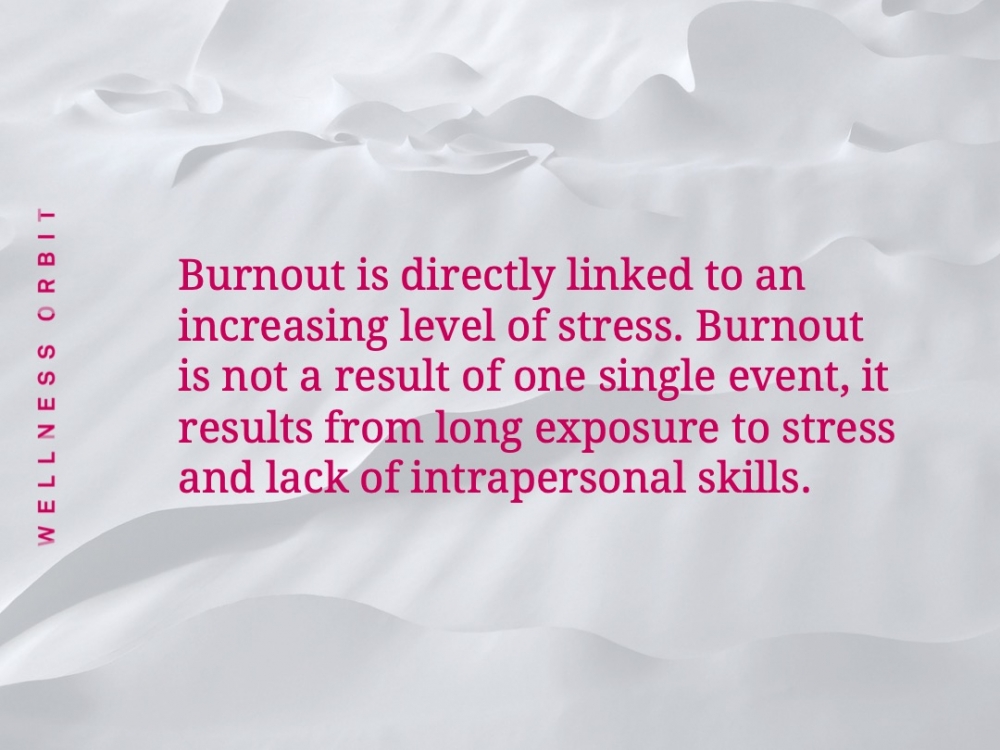 Reducing stress exposure is key to preventing burnout
Burnout prevention is the most important skill for sustaining performance, keeping your best talent, and long-term leadership effectiveness. Find out why awareness-based intrapersonal skills for self-leadership and securing mental wellness make all the difference in reducing stress and burnout risk.
Burnout is caused by repeated or chronic workplace stress and is a state of exhaustion on mental, emotional and physical levels. Burnout can cause reduced productivity and employee engagement, and lead to different health issues.
While burnout isn't an illness, it’s recognized by the World Health Organization as an occupational phenomenon.
Burnout is characterized by feelings of energy depletion, increased mental distance from one's job, and reduced professional efficacy.
Current Burnout Situation in the UK
According to the leading UK private medical insurance broker, WeCovr, burnout reached epidemic levels in the UK by the start of 2026. They register that:
- 79% of UK employees report experiencing burnout at some point, with 48% saying they have felt it within the last year.
- 'Presenteeism'—working while unwell—is a major issue. On average, employees who come to work despite poor mental health lose the equivalent of 30 working days of productive time per year.
- A staggering one-third of employees are considering changing jobs in the next 12 months, with burnout cited as a primary reason.
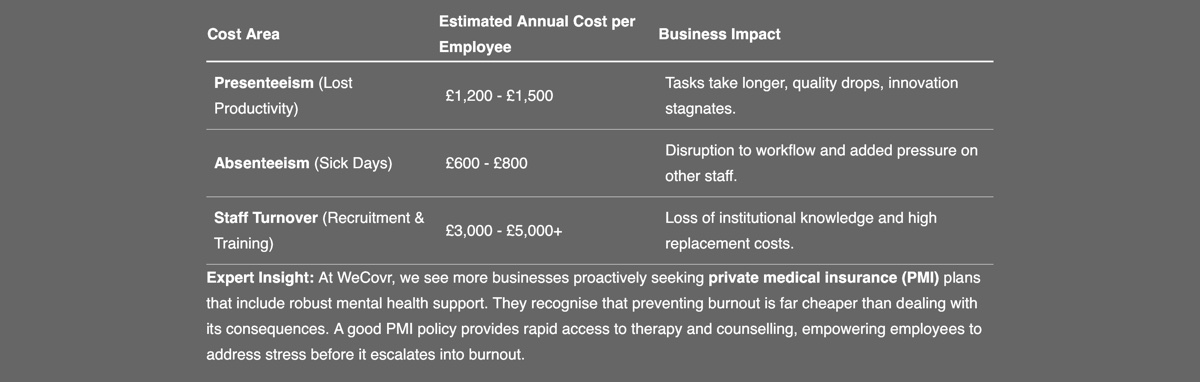
There is also a clear financial cost related to burnout, see the image below.
Current Burnout Situation in the U.S.
Burnout levels are also high in the U.S. According to Gallup, 28% of the U.S. workforce often or always feels burned out at work. At the same time, only 24% of workers report that they “rarely” or “never” feel burned out at work.
This means that 76% of the staff are in the danger zone, which is quite similar to the UK numbers above.
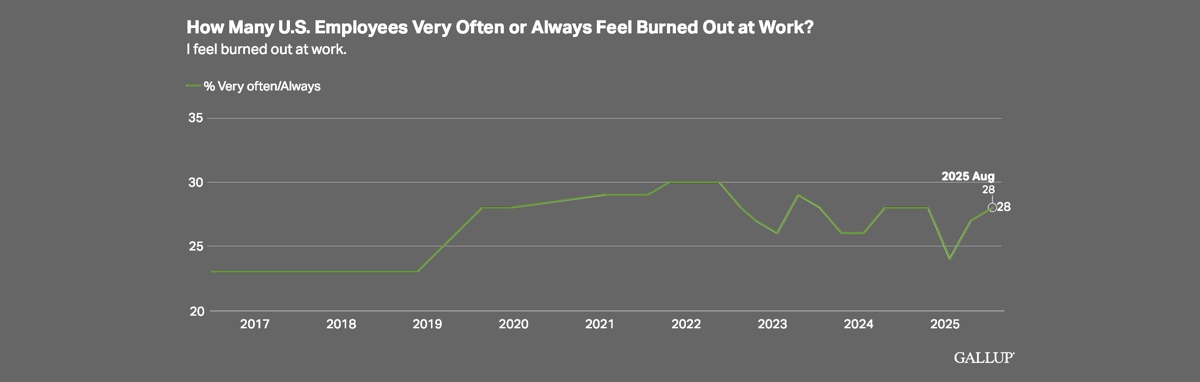
Gallup research has found that employees who report higher burnout (very often or always) are those who work more than 45 hours per week. As Jim Harter on the Gallup website states, „Leaders and managers should view signs of burnout as a red flag. Employees who say that they feel burned out very often or always are:
- 32% less likely to say they feel great responsibility for the quality of products/services their organization offers customers.
- 58% less likely to say their coworkers always do what is right for customers.
- 56% less likely to say their organization always delivers on the promise they make to customers.
- 74% more likely to be looking for another job.
In short, burned-out employees are unmotivated to serve customers and perform below their potential.“
According to ‘Workplace Well-Being in 2025: Insights from the Workplace and Employee Survey’ by WebMD Health Services, which included 4,001 full-time employees based in the U.S., „Compared to employees with low perception of care, those who strongly perceive that their organization cares about their well-being experience significantly more positive outcomes when compared to employees with a low perception of care. They are 56% more engaged in their work, 34% more likely to stay with their employer, and 37% less likely to experience burnout.“
Wake-up call: Burnout is 100% preventable
Burnout is 100% preventable, as it doesn’t happen overnight.
Burnout is the result individual's failure to deal with ongoing stress and overwhelming pressure, often compounded by a range of workplace factors. When lack of intrapersonal skills meets excessive workloads, low control over tasks, and failure to take time off and use their full holiday entitlement, the path to burnout is open.
Understanding the true impact of burnout is essential for any organization committed to securing the wellbeing of both employees and leaders.
Leaders are often even more open to burnout as their time schedules are tight and the daily pressure to deal with a variety of problems is high.
Additionally, the 'Always-On' culture, due to hybrid working standards, is now blurring the lines between home and work. This makes it even harder for people in all positions to find time to switch off properly.
According to Breathe HR, “81% of people agree or strongly agree that they notice increasing feelings of burnout, exhaustion, or poor mental health when they can’t take time off work.” They also report that “57% of UK workers admit to working either ‘sometimes’ or ‘often’ while taking booked leave.“
Breathe HR also reported that „58% of people said they were either ‘likely’ or ‘highly likely’ to take up to 5 days additional unpaid holiday a year, if given the option by their employer.“ It shows that people desire to care for their mental wellness.
What to track?
Employers should track a few key indicators to spot burnout trends, such as stress levels, absenteeism and staff turnover. Employee stress audits (built into the e-training Performing Under Pressure) can provide valuable insights to people. When we launched this training, we were surprised to find that the stress tests at the end of the training yielded worse results than those at the beginning. However, it is logical when we look into the reasons.
When starting the training, people evaluate their situation based on their existing knowledge of stress and burnout. Reality is that an individual's ability to spot their stress level was low. When they took training and improved their self-monitoring skills, they could clearly notice more warning signs and evaluate their actual stress level more adequately.

Project managers and leaders are on the front line of occupational health, and their training is vital in spotting both signs of stress and early warning signs of burnout.
Why? Besides burnout, chronic stress leads to different dysfunctional responses, resulting in heart disease, stomach ulcers, sleep dysregulation, and different psychiatric disorders.
The Constant Stress Problem and How to Solve It
When you face a stressful situation, your body subconsciously switches into a survival mode known as “fight or flight.” Stress hormones (adrenaline and noradrenaline) are released, increasing heart rate, blood pressure, energy levels, and mental alertness so you can respond quickly to danger.
As a result, blood is redirected to muscles, strength and focus increase, and extra glucose is released for fast energy. This response helps you act immediately, either to confront the threat or move away from it. Once the threat passes, the body gradually returns to its normal, calm state.
The problem with chronic stress is that your body never returns to normal, and you always feel on edge. This constant alertness to "fight or flight" depletes your brain and physical body and causes burnout.
Employers play a crucial role in providing resources to tackle the causes of stress and burnout head-on. Promoting systematic mental wellness training is the best and most feasible solution here.
The truth is, people lack intrapersonal leadership. Without the skills to lead your inner domain and change problematic intrapersonal processes, stress is impossible to reduce.
While reducing stressors matters, stress is, above all, inner reactivity. When people fail to respond adequately and instead react to every situation subconsciously, stress levels and burnout risk keep rising.
.jpg "Take a personal stress test and enjoy feedback!")
|
Intrapersonal skills aren't taught in schools or universities. Most parents also lack the skills to open up the hierarchy of the inner domain. So, what happens in our minds often remains a mystery to most of us. That is why a good mental wellness training is focused on training intrapersonal skills and understanding of self-leadership.
Also, healthy eating, encouraging regular work breaks, and supporting employees to take their planned holiday can support burnout prevention.
Open conversations about workload, setting realistic expectations, and providing access to stress reduction training, mental wellness training, and support services are all vital as well in securing mental wellness proactively.
Conclusion
The systematic proactive approach is what shows a genuine commitment to employee wellbeing. Investing in support and proactive mental wellness training creates a safer, healthier workplace where people feel valued and empowered.
One of the most necessary disciplines is learning to distinguish between what we can influence and what we can’t. Stressors around us are hard to remove, but the good news is that stress in your mind is something you can deal with when you learn practical intrapersonal skills and apply them in all work and life situations.
Ultimately, spotting the warning signs of stress, reducing stress, and preventing burnout benefits everyone. You and your staff become healthier and happier while seeing a more engaged, productive workforce. Intrapersonal skills matter; start learning them now.
This burnout prevention blog is provided by Kaur Lass